Product details description
Chain link fences are ubiquitous in securing perimeters, thanks to their
durability, affordability, and versatile diamond mesh pattern. Their journey
from raw steel wire to finished fencing involves multiple stages of
manufacturing, each engineered to produce a product that balances strength,
flexibility, and corrosion resistance.
It begins with steel wire production. High-carbon steel rods are drawn
through progressively smaller dies to achieve the desired gauge, enhancing
tensile strength. The wire is then cleaned and coated—galvanization being the
most common method, where it is immersed in molten zinc to form a protective
layer. Alternative coatings include vinyl or polyester, offering color options
and additional weather resistance.
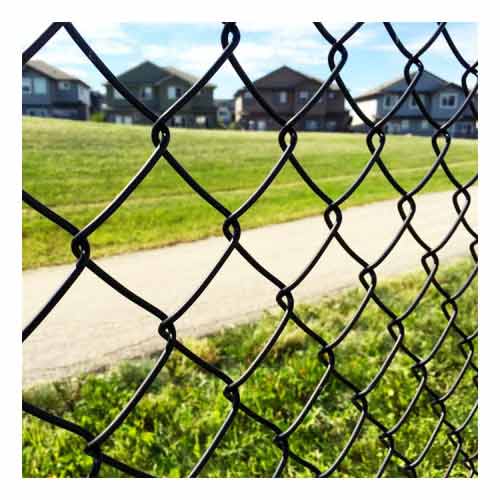
Next comes weaving. The coated wire is fed into automated weaving machines
that form the characteristic diamond mesh. Machines pull the wire to length,
loop it around tension bars, and interweave longitudinal and transverse strands
at fixed intervals. The diagonal crossing of wires creates the signature pattern
and distributes loads evenly, preventing localized failure under stress.
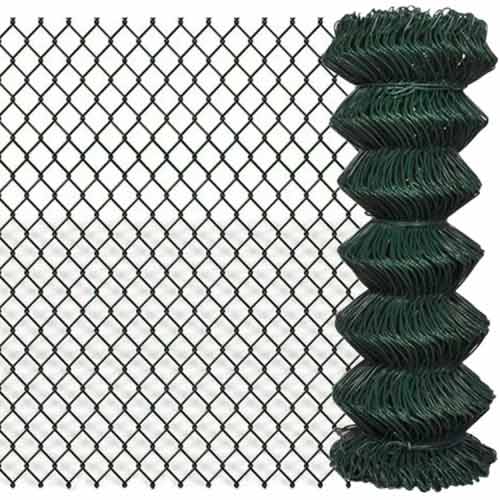
After weaving, the mesh is stretched and tensioned to eliminate slack and
ensure uniformity. This step is critical for structural integrity; improperly
tensioned mesh can sag or deform over time. Excess wire ends are trimmed, and
the mesh is rolled onto large spools or cut into standard panel sizes, ready for
fabrication into fences with frames and posts.
Posts and fittings complete the system. Steel tubing, often galvanized or
powder-coated, is cut and shaped into terminal posts, line posts, and top rails.
Fittings—clamps, caps, and braces—are manufactured to exact specifications,
allowing quick assembly. Installation hardware, including tension bands and
bolts, ensures panels are securely anchored to posts, resisting wind and impact
loads.
Quality control spans the entire process. Coil inspections verify wire
thickness and coating integrity; mesh checks confirm uniform diamond dimensions
and tension levels. Final assemblies undergo load testing to simulate real-world
stresses. Through precision engineering and rigorous standards, chain link
fences deliver reliable, long-lasting enclosure solutions for residential,
commercial, and industrial use.
Previous article:
How to Install Chain Link Fence Panels on Sloped or Uneven Ground
Next article:
DIY Chain Link Fence Installation: Step-by-Step Guide for Homeowners